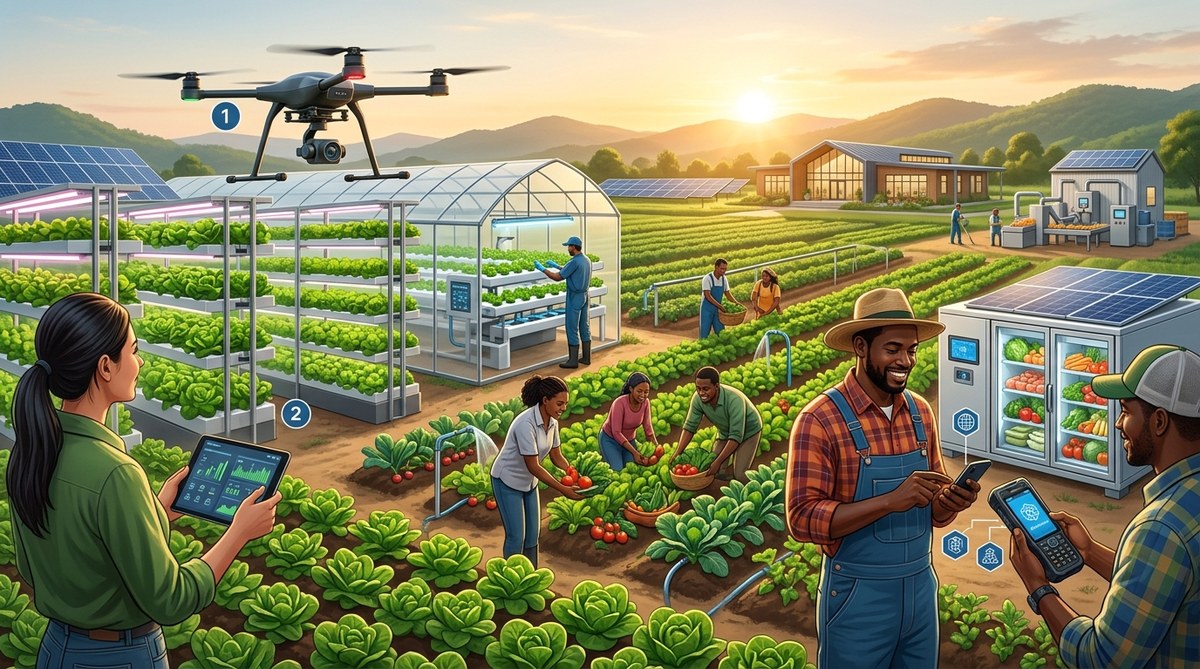
7 Food Security Innovations That Are Saving Lives in 2026
In 2026, feeding a growing planet is more urgent than ever. New tools and strategies are changing how we grow, distribute, and access food. These innovations aren’t just theoretical. They are saving lives right now in communities from rural Kenya to urban food deserts in the United States. The goal is simple: make sure everyone has enough nutritious food, no matter where they live. Let’s look at the most promising food security innovations 2026 has brought to the table.
Food security innovations in 2026 combine high tech solutions with grassroots community power. Precision agriculture, AI driven logistics, climate resilient seeds, mobile money, vertical farming, food waste apps, and local seed banks are all working together. No single fix will end hunger, but these seven approaches are already cutting waste, boosting yields, and getting food to those who need it most.
Precision Agriculture for Smallholder Farmers
Small farmers grow most of the world’s food, but they often lack access to data. In 2026, affordable sensors and satellite imagery are changing that. Farmers in India, Nigeria, and even parts of the American Midwest now receive text alerts about soil moisture, pest outbreaks, and the best planting times. These tools reduce crop loss by up to 30 percent in some regions.
A practical example is the use of drone swarms to map fields and apply fertilizer only where it’s needed. This saves money and keeps chemicals out of waterways. For policymakers, supporting these technologies means investing in internet access and low cost devices. For researchers, it means refining algorithms to work across different climates.
AI Powered Food Distribution
Getting food from farms to tables is a huge challenge. Spoilage and poor logistics waste about one third of all food produced. In 2026, artificial intelligence is helping fix that. Nonprofits and governments use AI to predict demand, reroute deliveries around road closures, and match surplus food with local food banks.
For example, a program in Brazil uses machine learning to connect farmers with school meal programs. The system calculates the best routes and schedules, cutting delivery times by half. This innovation is especially important for remote communities where a broken truck can mean weeks without fresh food. You can read about similar approaches in harnessing technology to improve food distribution in developing countries.
Climate Resilient and Biofortified Seeds
Climate change is making traditional crops less reliable. Droughts, floods, and new pests are becoming more common. In 2026, seed banks and biotech labs are releasing varieties that can handle these stresses. Some are bred naturally, others use gene editing to add traits like heat tolerance or higher vitamin content.
Consider orange flesh sweet potatoes, which are rich in vitamin A and grow well in dry soils. They are now a staple in parts of sub Saharan Africa. Similarly, flood resistant rice varieties are protecting harvests in Bangladesh. These seeds are not a silver bullet, but they give farmers a fighting chance.
“The most effective food security innovations 2026 are the ones that work with nature, not against it. We need seeds that adapt, not just chemicals that protect.” – Dr. Ana Torres, agronomist with the World Food Programme.
Mobile Money and Digital Vouchers
Cash transfers have long been used in humanitarian aid, but mobile money makes them faster and more transparent. In 2026, millions of families receive digital vouchers that can be exchanged for food at local markets. This supports the local economy while giving people choice.
Syrian refugees in Jordan use iris scan payments at grocery stores. Smallholder farmers in Ghana get paid instantly for their crops via mobile wallets. The system also helps aid organizations track spending and prevent fraud. For researchers studying food security innovations 2026, this is a clear example of technology serving human dignity.
Vertical Farms and Urban Agriculture
Cities are growing, and so is the distance food travels to reach them. Vertical farms, where crops grow in stacked layers under LED lights, are now cost competitive in many urban centers. In 2026, vertical farms supply fresh lettuce, herbs, and even strawberries to grocery stores within a few miles.
The key breakthrough is energy efficiency. New LEDs use 40 percent less electricity than earlier models, and some farms are powered by solar panels. Community gardens also play a big role. In places like Detroit and Phoenix, residents are turning vacant lots into productive green spaces. These efforts improve access to fresh produce in food deserts. For a deeper look, see how community gardens are tackling food deserts across America.
Food Waste Reduction Apps and Platforms
In the United States alone, households throw away about $1,500 worth of food each year. In 2026, apps that connect consumers with surplus food from restaurants, bakeries, and farms are becoming mainstream. Users buy discounted meals or groceries that would otherwise be discarded. Some apps also allow individuals to donate food to shelters with a few taps.
For humanitarian workers, similar platforms are being used in refugee camps. Surplus food from aid shipments is redistributed to families before it spoils. This reduces waste and stretches limited budgets. And remember, reducing food waste is one of the simplest ways to fight hunger.
Community Led Seed Banks and Knowledge Sharing
Not every innovation requires a smartphone or satellite. In 2026, local seed banks run by communities are preserving traditional crop varieties that are naturally hardy. Women farmers in Nepal and Guatemala are leading these efforts. They save seeds from the best plants each season, then share them with neighbors. This local resilience is often overlooked by large aid programs.
These seed banks also serve as training centers. Farmers learn about soil health, composting, and natural pest control. A study from the Food and Agriculture Organization found that communities with active seed banks are 40 percent less likely to experience severe hunger during droughts. It is a low tech, high impact innovation that deserves more support.
| Innovation | Primary Benefit | Key Challenge |
|---|---|---|
| Precision agriculture | Higher yields, less waste | Requires internet access |
| AI food distribution | Less spoilage, faster delivery | Data quality and privacy |
| Climate resilient seeds | Adapts to extreme weather | Cost of development |
| Mobile money vouchers | Empowers local markets | Digital literacy |
| Vertical farming | Fresh food in cities | High upfront costs |
| Food waste apps | Reduces landfill, saves money | User adoption |
| Community seed banks | Preserves biodiversity | Needs strong local organization |
A Step by Step Plan to Start a Community Seed Bank
If you work with a community that wants to start a seed bank, here are three steps:
- Hold a meeting with local farmers to identify the most important crops.
- Collect seeds from the healthiest plants and store them in airtight containers, labeled with the date and variety.
- Set up a sharing system: each member returns twice the seeds they take after the harvest.
This simple process can be expanded with support from agriculture extension officers or NGOs.
Why These Innovations Work Together
No single technology or program will solve hunger. The power of food security innovations 2026 comes from how they reinforce each other. AI tools help distribute climate resilient seeds. Mobile money allows farmers to buy those seeds. Vertical farms reduce pressure on rural land. Food waste apps keep edible food out of landfills. Community seed banks preserve genetic diversity that might be needed for future climate shifts.
For researchers, this means studying systems, not just individual interventions. For policymakers, it means funding a mix of high tech and community based approaches. For humanitarian workers, it means listening to local needs and adapting tools accordingly. And for students, it means understanding that food security is not just about producing more food, but about making sure it reaches people in a way that respects their dignity.
To explore more about how these strategies are being applied in real world settings, read about innovative strategies to combat hunger in vulnerable communities and building resilient food systems to end global hunger.
The Road Ahead
The innovations we’ve covered are already changing lives in 2026. But there is still a long way to go. Hunger affects nearly 800 million people worldwide. Conflict, economic shocks, and climate disasters continue to push families into food insecurity. Yet the tools exist to make a real difference. The challenge is scaling them up and making them accessible to everyone.
If you are a researcher, look for gaps in the data. If you are a policymaker, prioritize funding for proven solutions. If you are a humanitarian worker, bring these ideas to the field. And if you are a student, learn about the systems that keep food moving from farm to fork. Every step matters. Together, we can turn food security innovations 2026 into lasting change.