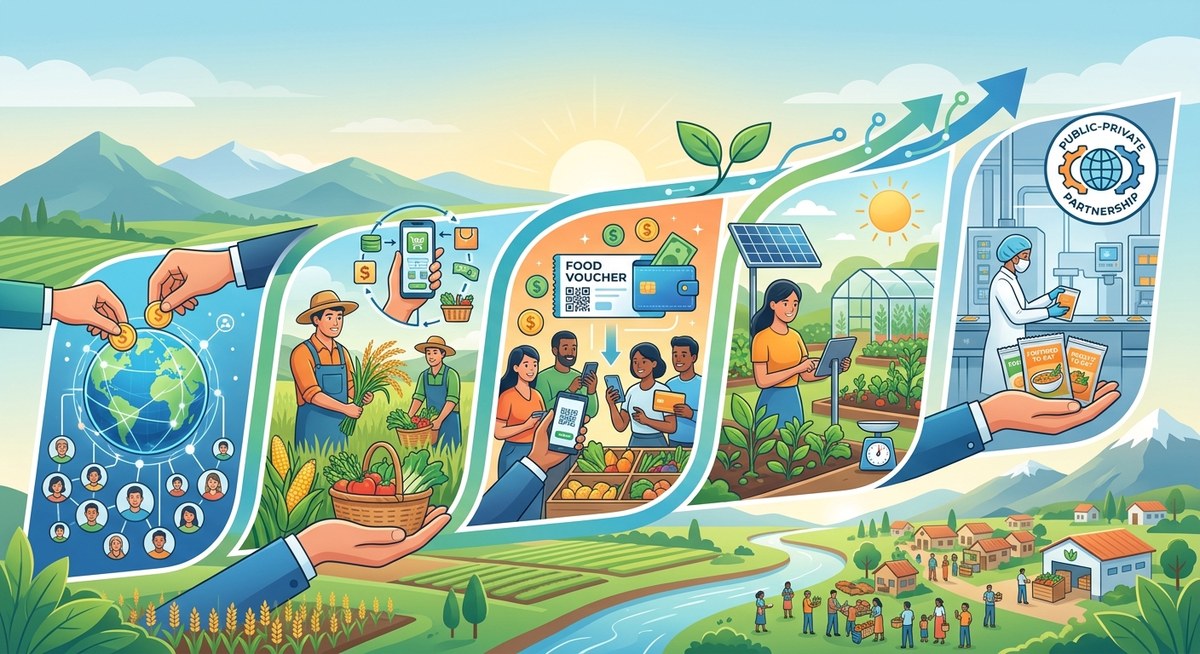
5 Innovative Funding Models That Are Revolutionizing Food Aid
For decades, funding food aid meant relying on a small set of traditional donors and government grants. But those models are cracking under the pressure of rising demand, climate shocks, and supply chain disruptions. Today, a wave of new financing approaches is helping NGOs and policymakers stretch every dollar further and reach more people in need. These are the innovative funding models for food aid that are making a real difference. They shift risk, attract private capital, and tie results to actual outcomes. Let’s walk through five of the most promising ones.
Traditional food aid funding is too rigid for today’s crises. Innovative models like blended finance, social impact bonds, crowdfunding, debt-for-food swaps, and blockchain disbursements give development professionals flexible, results-driven tools. These approaches lower risk for investors, reward efficiency, and reach more people. By layering private capital with public dollars, they make every contribution go further and create more sustainable food security programs.
Why Old Funding Models Are Not Enough
Government grants and bilateral aid have been the backbone of food assistance for decades. They are predictable, but they are also slow and often tied to political cycles. When an emergency hits, emergency funds can take months to arrive. Meanwhile, local food systems collapse and malnutrition rates spike.
Development professionals need tools that move money faster, reward performance, and leverage resources from outside the traditional aid ecosystem. That is where innovative funding models for food aid come in. They are not replacements for public funding. They are complements that make the whole system more agile.
5 Innovative Funding Models for Food Aid in 2026
Each model below solves a specific pain point. Some attract new capital. Others improve efficiency. A few do both.
1. Blended Finance Structures
Blended finance layers concessional capital (from governments or foundations) with private investment to lower the risk for commercial investors. A small grant might cover first losses, making it safe for a pension fund to put money into a food distribution program.
How it works in practice: A development agency provides a 20% first-loss guarantee. Private investors contribute the remaining 80%. If the program underperforms, the guarantee absorbs initial losses. If it succeeds, investors get a modest return, and the community gets reliable food aid.
Steps to set up a blended finance vehicle for food aid:
- Identify a measurable food security outcome (e.g., reduce acute malnutrition by 30% in a target region).
- Secure a first-loss tranche from a donor or philanthropic foundation.
- Structure the investment vehicle with clear risk-return profiles.
- Recruit impact investors (e.g., social investment funds, family offices).
- Implement the program with local partners and a rigorous monitoring system.
This model works well when you need scale beyond traditional aid budgets. It is especially useful for long-term resilience projects like school feeding programs or climate-smart agriculture.
2. Social Impact Bonds (Pay for Success)
Social impact bonds tie funding to verified results. Private investors front the capital. The government or donor repays them only if the program hits predefined targets. If the program fails, investors take the loss.
Example: A city government wants to reduce food insecurity among schoolchildren. An NGO runs a nutrition program. Private investors provide the upfront cash. If the children’s nutritional status improves by a set percentage, the city repays the investors with a small return. If not, no repayment is due.
Benefits of this model:
- Risk is shifted from taxpayers to private investors.
- Focus on measurable outcomes, not just inputs.
- Encourages innovation because programs must prove they work.
- Can be scaled across multiple communities.
The main challenge is setting up the evaluation metrics and data collection. But once the infrastructure is in place, impact bonds can fund food aid more efficiently than traditional grants.
3. Digital Crowdfunding Platforms
Crowdfunding is not new, but its application to food aid has become more sophisticated. Platforms now allow donors to fund specific projects in real time, and nonprofits use matching campaigns to multiply contributions.
What has changed in 2026: Blockchain-based crowdfunding adds transparency. Donors can see exactly where their money goes. Smart contracts release funds only when agreed milestones are met. This builds trust and reduces administrative overhead.
A school in rural Kenya might use a platform to raise money for a breakfast program. Donors from the US contribute directly, and a smart contract releases funds each month based on attendance records. No middleman, no delays.
4. Debt for Food Swaps
This model is adapted from debt for nature swaps. A creditor country or bank agrees to cancel a portion of a developing country’s debt. In exchange, the debtor country commits to spending an equivalent amount on food security programs.
How it works: Country A owes $100 million to Country B. Country B agrees to forgive $50 million. Country A then allocates $50 million of its own budget to a domestic food aid fund. The result: debt relief plus new money for hunger programs.
This model strengthens national ownership and creates a predictable funding stream. It is particularly powerful for countries with high debt burdens and high malnutrition rates.
5. Blockchain Based Disbursement Systems
Blockchain is not just for crowdfunding. It can change how food aid money flows through the entire supply chain. Smart contracts automatically release payments when delivery conditions are met, reducing fraud and delays.
Example: A World Food Programme pilot in Jordan used blockchain to give refugees digital vouchers for food purchases. Every transaction was recorded, and funds were released only when the voucher was used. The system cut administrative costs by nearly 98%.
Comparison of techniques and common mistakes:
| Technique | Best For | Common Mistake |
|---|---|---|
| Blended finance | Scaling long term resilience programs | Ignoring local currency risk |
| Social impact bonds | Outcome focused interventions | Setting too many targets (overcomplication) |
| Digital crowdfunding | Grassroots / emergency response | Poor communication of impact to donors |
| Debt for food swaps | Highly indebted countries | Not aligning with national food policy |
| Blockchain disbursement | Reducing fraud in large supply chains | Underestimating digital infrastructure needs |
“The biggest shift I see is that funders are finally asking ‘what works’ instead of ‘how much did you spend’. These innovative funding models for food aid force us to prove value, and that is making every dollar more effective.”
* Maria Santos, Senior Advisor for Food Systems at the Global Resilience Institute
How to Choose the Right Model for Your Program
No single model fits every context. You need to match the tool to the problem.
- Use blended finance when you need to attract private capital to a proven intervention.
- Use social impact bonds when you can measure outcomes clearly and have a government willing to pay for success.
- Use digital crowdfunding for quick, community driven responses or pilot projects.
- Use debt for food swaps when working with heavily indebted governments that want to own their food security agenda.
- Use blockchain disbursement when you manage large scale supply chains and need to reduce leakage.
For a deeper look at how technology is reshaping these systems, check out breakthrough technologies in food security.
Putting These Models into Action
Transitioning from traditional funding to innovative models takes preparation. You will need strong data systems, willing partners, and a tolerance for some experimentation. But the payoff is huge: more food reaches more people, donors see real impact, and your program becomes more resilient to funding shocks.
Start small. Pick one model and pilot it alongside existing funding. Track results. Then scale what works. The innovative strategies to combat hunger guide offers a step-by-step framework for building these programs from the ground up.
Food aid in 2026 does not have to be a gamble. With the right funding model, you can turn uncertainty into reliability and help communities build lasting food security. Try one of these approaches in your next project. The difference it makes might surprise you.