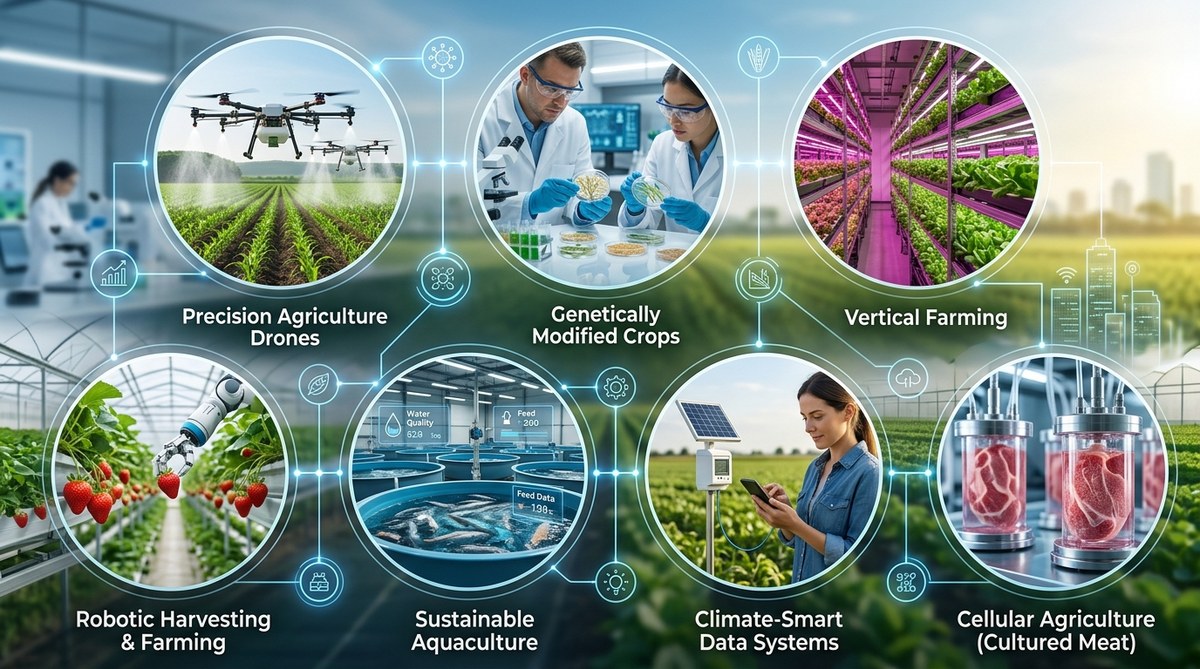
7 Breakthrough Technologies Revolutionizing Food Security in 2026
The global food system is under incredible strain. By 2026, climate volatility, supply chain disruptions, and population growth have pushed more than 800 million people into chronic hunger. But there is real reason for optimism. A wave of technological breakthroughs is reshaping how we grow, distribute, and consume food. These innovations are not science fiction. They are being deployed right now in fields, labs, and kitchens across the world. For tech professionals, researchers, and investors, understanding these tools is the first step toward backing solutions that work. Let's look at the seven most powerful food security breakthrough technologies that are defining 2026.
Seven breakthrough technologies are dramatically improving food security in 2026: AI-driven precision farming, gene editing for crop resilience, cellular agriculture, vertical farming with renewable energy, blockchain for supply chain transparency, soil microbiome engineering, and floating solar farms for irrigation. Together they offer a scalable, sustainable path to ending hunger.
Seven Breakthrough Technologies Redefining Food Security in 2026
The following technologies are not just promising concepts. They are already moving from pilot projects to large scale deployment. Each one addresses a specific bottleneck in the food system, from production to distribution to waste reduction.
1. AI Driven Precision Farming
Artificial intelligence is now the brain behind many farms. Sensors, drones, and satellite imagery feed data into machine learning models that predict the exact amount of water, fertilizer, and pesticide a crop needs. This cuts waste by up to 40 percent and boosts yields in vulnerable regions. For example, smallholder farmers in sub Saharan Africa are using AI powered mobile apps to receive daily planting advice tailored to local weather patterns.
2. Gene Editing with CRISPR for Crop Resilience
CRISPR technology has matured beyond the lab. In 2026, regulatory approvals have opened the door for drought tolerant wheat, disease resistant cassava, and rice varieties that thrive in saline soils. These crops require less chemical input and can survive harsh conditions linked to climate change. This is a direct answer to one of the biggest food security challenges: how to grow more food on degrading land.
3. Cellular Agriculture and Fermentation
Cellular agriculture is finally scaling. Companies are producing animal proteins directly from cell cultures, eliminating the need for vast amounts of land and water for livestock. At the same time, precision fermentation is creating dairy proteins, egg whites, and even fats without animals. These products are becoming cost competitive with conventional equivalents. The environmental footprint is a fraction of traditional farming.
4. Vertical Farms Powered by Renewable Energy
Vertical farming has gone mainstream in 2026, especially in urban centers. New generation vertical farms use LED lights tuned to specific light spectra and are powered entirely by solar or wind energy. They grow leafy greens, herbs, and even strawberries year round with 95 percent less water than field farming. Cities like Tokyo, London, and Dubai are building vertical farm clusters within food deserts.
5. Blockchain for Transparent Supply Chains
Food waste and fraud cost billions every year. Blockchain technology now enables end to end traceability from farm to table. Each transaction is recorded on a distributed ledger that cannot be altered. This helps identify spoilage points quickly, ensures fair payments to farmers, and allows consumers to verify the origin of their food. For humanitarian organizations, this means aid can be tracked and delivered far more efficiently.
6. Soil Microbiome Engineering
Healthy soil is the foundation of food security. Scientists have mapped the complex communities of bacteria and fungi that live in soil. In 2026, companies are selling microbial cocktails that restore degraded soil, increase nutrient uptake, and suppress pathogens naturally. This reduces the need for synthetic fertilizers, which are expensive and environmentally damaging. It is a low cost, high impact solution for smallholders.
7. Floating Solar Farms for Irrigation
Water scarcity is a growing threat to agriculture. Floating solar panels on reservoirs and canals generate clean electricity while reducing evaporation. The power can run irrigation pumps and desalination units. In India and Bangladesh, floating solar irrigation projects are helping farmers grow crops during dry seasons. The technology is simple to deploy and has a double benefit: energy and water conservation.
How These Technologies Work Together
No single technology can solve food security alone. The real magic happens when they are combined. For example, AI precision farming can tell a farmer exactly where to apply a microbial soil treatment. Blockchain can verify that the resulting crop was grown sustainably. Cellular agriculture can supplement protein supply without requiring additional land. This integrated approach multiplies the impact.
To visualize the synergy, here is a table showing how each technology addresses a specific food system challenge:
| Technology | Primary Food Security Challenge | Key Benefit in 2026 |
|---|---|---|
| AI Precision Farming | Input waste and low yields | Reduces fertilizer and water use by up to 40% |
| CRISPR Gene Editing | Climate vulnerability | Creates drought and salt tolerant crops |
| Cellular Agriculture | Land and water overuse | Produces protein with 90% less land |
| Vertical Farming (Renewable) | Urban food deserts | Provides fresh produce locally year round |
| Blockchain | Supply chain fraud and waste | Enables full traceability and fair payments |
| Soil Microbiome Engineering | Soil degradation | Restores fertility without synthetic chemicals |
| Floating Solar Farms | Water and energy scarcity | Powers irrigation while conserving water |
Practical Steps for Researchers and Investors
If you are a researcher or investor looking to support these technologies, here are three action oriented steps to consider:
-
Identify regional needs. The most impactful solutions are often those adapted to local conditions. A drought resistant rice variety matters more in Southeast Asia than in Northern Europe. Map the specific vulnerabilities of the area you want to serve.
-
Fund integrated pilot projects. Instead of backing a single gadget, look for projects that combine hardware and software. For instance, a program that provides AI sensors plus soil microbial treatments plus blockchain tracking will produce more resilient results than any piece alone.
-
Support open data initiatives. Many breakthroughs rely on data sharing. Advocating for open access weather and soil data can help smallholders access AI tools that were previously only available to large agribusinesses.
"The most exciting development in 2026 is not any single invention. It is the convergence of digital biology, renewable energy, and decentralized financing. That combination is what will finally make food security scalable."
Dr. Amara Nkosi, Food Systems Researcher at the University of Nairobi
What This Means for Communities on the Ground
Technology alone is not enough. It must reach the people who need it most. Community led programs that pair these innovations with local knowledge have shown the highest success rates. For example, in rural Kenya, farmers using AI weather alerts combined with drought resistant seeds have doubled their maize harvests over two seasons. Similar results have been seen in programs supported by organizations like Food First. To see how these efforts are being implemented globally, check out innovative strategies to combat hunger in vulnerable communities and building resilient food systems to end global hunger.
The Path Forward for a Food Secure Future
The year 2026 marks a turning point. The tools to end hunger are now within reach, but they require deliberate investment, collaboration, and political will. Researchers must keep testing and refining these technologies. Investors need to bet on systems, not just hardware. And communities must be empowered to adopt what works best for them.
If you work in tech, research, or philanthropy, you have a role to play. Whether it is funding a soil microbiome startup, deploying blockchain in a supply chain, or simply learning more about these breakthroughs, every action counts. Start by exploring how your organization can partner with community led food security programs. The future of food is being built right now, and it is more hopeful than it has been in decades.