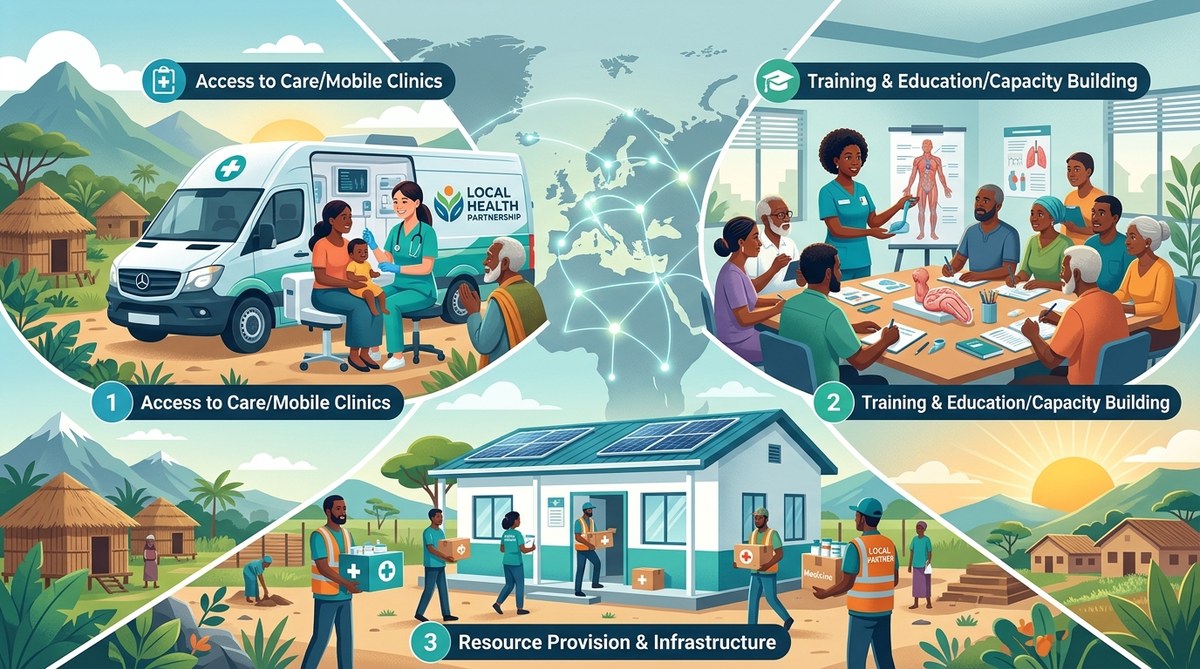
3 Ways Local Partnerships Are Closing Healthcare Gaps Worldwide
About 4.5 billion people today lack full access to essential health services. That number feels overwhelming, but a growing body of evidence points to a surprisingly simple solution. The most effective work happens not in distant capitals or global boardrooms but inside communities themselves. When local leaders, clinics, and nonprofits team up with outside supporters, they create care systems that actually stick. This is what closing healthcare gaps through local partnerships looks like in practice, and the results are reshaping how we think about global health equity.
Local partnerships are the engine of scalable, sustainable healthcare change. By shifting power to community actors, global health organizations can close access gaps faster and more equitably. This article outlines three proven partnership models, common mistakes to avoid, and how technology can strengthen these bonds. Whether you work in policy, direct service, or funding, these insights will sharpen your approach to closing healthcare gaps through local collaboration.
Why Local Partnerships Belong at the Center of Your Strategy
Top-down programs often fail because they don’t fit the cultural or logistical reality on the ground. A mobile clinic schedule that works in Ohio might make no sense in rural Malawi. A vaccination campaign designed in Geneva can miss the trust barriers that matter most in a remote village. Local partnerships solve that by putting decision making closer to the people who need care.
Here are the key advantages of this approach:
- Trust is already built. Community health workers know their neighbors. They speak the language and understand local customs. That trust cuts through vaccine hesitancy and misinformation faster than any billboard.
- Logistics become simpler. Partnering with a local clinic means you don’t have to build a supply chain from scratch. They already know where the roads wash out and which markets have medicine.
- Costs drop significantly. When you collaborate with existing structures, you avoid duplicate spending on infrastructure, salaries, and transport. Every dollar goes further.
- Outcomes improve. Studies consistently show that community-led interventions have higher adherence rates, lower dropout rates, and better long-term health indicators.
“The communities we serve are not our patients. They are our partners in health. When we stop telling them what to do and start asking them what they need, the gaps begin to close.” — Dr. Amina Fofana, Director of Community Health Partnerships, West Africa Health Alliance
Three Practical Steps to Build and Sustain Local Health Partnerships
Not all partnerships are equal. The ones that actually close healthcare gaps follow a repeatable process. Here is a three step framework you can adapt to your own context.
-
Map the existing ecosystem before you act. Visit the area. Meet with local government health officers, traditional healers, school principals, and women’s groups. Ask them about their biggest frustrations and what they already have in place. Do not assume you know what the gaps are. One NGO in northern Ghana learned that mothers were skipping prenatal visits not because of cost but because the clinic had no female staff. That insight only came from listening first.
-
Co-design every intervention with local leaders. Bring community representatives into the planning meetings from day one. Let them set the priorities, choose the delivery methods, and define success. This is not a handoff. It is a true collaboration. For example, a partnership between Food First and a network of community health workers in Honduras designed a nutrition screening program that used local foods instead of imported supplements. The result was higher enrollment and lower cost.
-
Create a shared accountability loop. Agree on simple metrics that both sides can track. Then schedule regular check-ins to review progress, celebrate wins, and fix problems together. Transparency builds trust. The team should use tools like shared dashboards, monthly calls with translation support, and joint field visits. Avoid rigid reporting requirements that feel like monitoring. Instead, frame it as mutual learning.
Common Mistakes and How to Avoid Them
Even well intentioned partnerships can stumble. The table below shows frequent pitfalls and practical fixes.
| Mistake | Solution |
|---|---|
| Treating the local partner as a subcontractor rather than a co-owner | Write a memorandum of understanding that shares decision making authority. Include the local partner in budget discussions and grant writing. |
| Rushing the relationship building phase | Invest at least two to three months in trust building before launching any program. Hold informal meetings. Share meals. Listen without agenda. |
| Ignoring power dynamics around money and status | Be transparent about funding sources and amounts. Offer to pay local partners fair wages, not just stipends. Acknowledge their expertise publicly. |
| Using a one size fits all training model | Adapt training materials to local literacy levels, languages, and learning styles. Use pictures, role plays, and hands on practice. |
| Stopping the partnership after the funding ends | Build exit strategies that leave behind skills, equipment, and local ownership. Aim for the partner to run the program independently within three years. |
Strengthening Partnerships With Technology and Training
Local partnerships do not mean rejecting modern tools. In fact, the right technology can make those bonds stronger. Telemedicine platforms, for example, allow a community health worker in a remote village to consult a specialist in a city hospital. That keeps care local while bringing in higher level expertise. You can read more about this in our guide on bridging healthcare gaps in underserved communities with telemedicine solutions.
Training is another critical piece. When you invest in building the skills of local health workers, you are investing in sustainability. Consider programs that teach data collection, basic diagnostics, and community engagement. One successful model trains community health workers to use mobile apps for tracking patient outcomes, and then feeds that data back to the clinic for better resource allocation. For a deeper look at this approach, check out how community health workers are transforming healthcare access in underserved areas.
Mobile clinics also play a huge role. When a fixed clinic cannot reach every village, a mobile unit staffed by local nurses and drivers can fill the gap. The key is to partner with a local transportation company or community council to handle maintenance and scheduling. Our article on expanding healthcare access in remote communities through mobile clinics shares more details on how to set these up.
Measuring What Matters in a Partnership
Numbers matter, but they are not everything. When you are closing healthcare gaps, you need to track both quantitative and qualitative indicators. Here are some metrics that partnerships should monitor together:
- Percentage of target population reached with basic services (vaccinations, prenatal care, etc.)
- Average wait time for an appointment
- Patient satisfaction scores collected by local staff
- Retention rate of community health workers
- Number of referrals made and completed
- Cost per patient compared to a non partnership baseline
Gather this data every quarter and share it openly. When a number drops, do not blame. Instead, ask why. The answer will almost always lead to a system fix that the partnership can make together.
A Vision for the Future of Global Health Equity
Local partnerships are not a shortcut. They are the long road that actually arrives. In 2026, we are seeing a shift away from donor driven projects and toward community owned solutions. Organizations like Food First are proving that when you treat local partners as equals, healthcare gaps shrink faster and more fairly.
If you are a policymaker, start by requiring community engagement plans in every health grant you oversee. If you are an NGO leader, invest your best staff time in building relationships, not just writing reports. If you are a global health professional, bring a local health worker into every strategy meeting. And if you are a donor, fund the messy, slow, beautiful work of partnership building. That is where the real change lives.
The path to closing healthcare gaps through local partnerships is already being paved by thousands of dedicated groups around the world. Your role is to join them, support them, and learn from them. Start today by reaching out to one community organization near the region you serve. Ask them one question: “What would make your work easier?” Then listen. Then act together.