7 Ways Food Banks Are Using AI to Predict Supply Shortages Before They Happen
Picture a food bank warehouse on a Tuesday morning. A truck from a national grocery chain arrives with three pallets of fresh dairy, but the inventory system shows the refrigerator is already full. Meanwhile, a neighborhood pantry twenty miles away is about to run out of milk entirely. That mismatch happens every day across the United States. It leads to spoiled food on one end and empty shelves on the other.
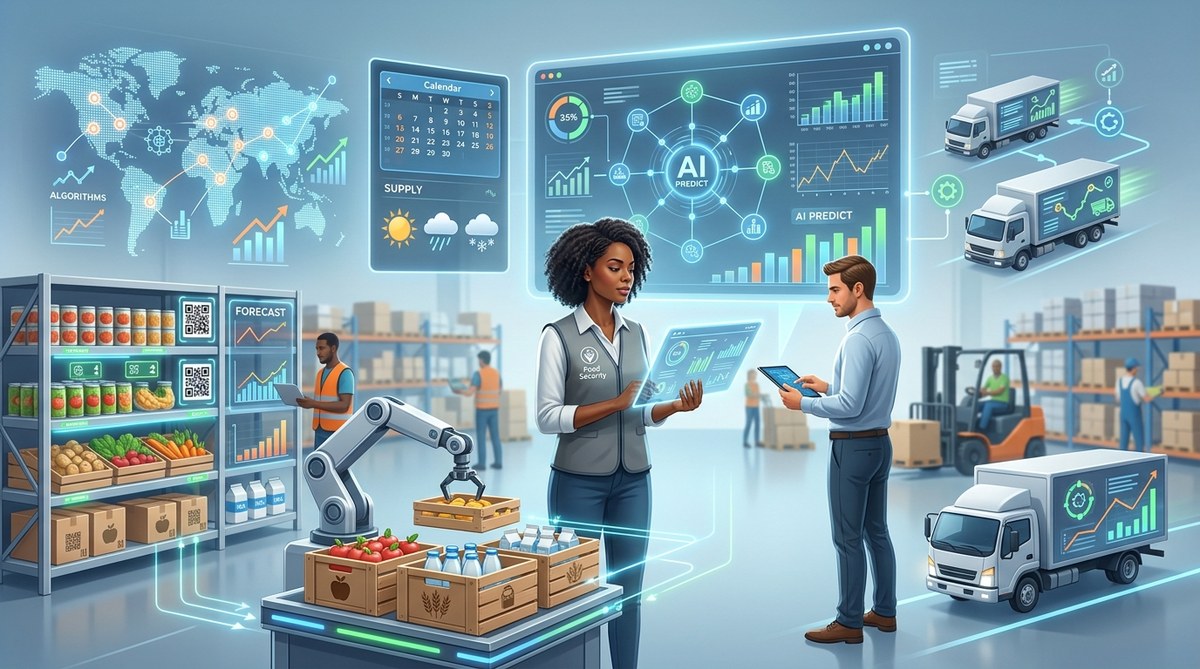
Artificial intelligence is changing that picture. By analyzing donation patterns, demographic shifts, weather data, and even local school calendars, machine learning models can now forecast a shortage weeks before it occurs. This gives food bank operations managers time to adjust orders, reroute deliveries, and coordinate with partner agencies. The result is less waste, fuller pantries, and families who get the food they need.
AI in food banks supply prediction is not a futuristic concept. It is a practical tool already used by networks across the country to forecast demand, reduce spoilage, and match surplus donations with verified need. This article explains how these systems work, what data they use, and how your organization can adopt them.
Why food banks need prediction tools
Food banks operate on thin margins. A single unexpected surge in demand can empty the shelves. A single donation shortfall can leave thousands of families without a meal. Traditional inventory planning relies on historical averages, but averages miss the spikes. They do not account for a factory closure that throws a thousand people out of work, or a snowstorm that closes roads and stops deliveries.
AI models handle that complexity. They ingest data from dozens of sources and learn to spot patterns humans would miss. For example, a model might notice that when the local school district schedules parent-teacher conferences on a Thursday, pantry visits rise by 12% the following Monday. That insight lets the operations manager order extra shelf-stable milk on Wednesday.
“The biggest shift we have seen is moving from reactive to proactive logistics. Instead of waiting for a shortage and scrambling, we can see it coming three weeks out and redirect resources before anyone goes hungry.” Operations director at a regional food bank network in the Midwest
How AI predicts supply shortages
The core of any prediction system is a machine learning model trained on historical data. The model learns which variables correlate with shortages and then applies that knowledge to new data. Here are the key steps in that process.
1. Data collection
The system pulls data from multiple sources:
- Donation records: what came in, when, and from whom
- Distribution logs: what went out, to which pantries, and on what dates
- External feeds: weather forecasts, unemployment claims, school calendars, and holiday schedules
- Census data: population changes, poverty rates, and SNAP enrollment numbers
2. Feature engineering
Raw data is transformed into features the model can use. For instance, “day of the week” becomes “is it a Friday before a holiday weekend?” and “temperature” becomes “is it above 90 degrees, which increases demand for bottled water?”
3. Model training
A supervised learning algorithm, often a gradient-boosted tree or a recurrent neural network, is trained on past years of data. The model learns to predict a target variable, such as “pounds of food needed next week” or “probability of a protein shortage in 14 days.”
4. Alert generation
When the model predicts a shortage probability above a certain threshold, it sends an alert to the logistics team. The alert includes the likely timing, the affected food category, and the suggested response.
A practical numbered list for implementation
If your organization wants to adopt AI in food banks supply prediction, here is a step-by-step path.
-
Audit your existing data. Before any model can work, you need clean, consistent records. Start with your donation and distribution logs. Fill in gaps. Standardize units (pounds, cases, servings). This step alone often reveals inefficiencies.
-
Choose a prediction horizon. Do you need a 7-day forecast or a 30-day forecast? Shorter horizons are easier to model but give you less time to act. Longer horizons require more data and carry more uncertainty.
-
Select your features. List the external factors that affect your supply chain. Common ones include weather, school holidays, benefit disbursement dates, and local employer layoffs. Test each feature for correlation with your target variable.
-
Pick a model type. Start simple. A linear regression or random forest can outperform a complex neural network when data is sparse. Upgrade to more sophisticated models only after you have a baseline.
-
Set alert thresholds. Decide how much false positive risk you can tolerate. A low threshold catches more shortages but also triggers more false alarms. A high threshold reduces noise but may miss real events.
-
Integrate with your logistics system. The prediction is useless if it sits in a spreadsheet. Connect the model output to your inventory management or routing software so alerts trigger automatic actions.
-
Review and retrain regularly. Models drift as conditions change. Retrain your model quarterly or after any major disruption, like a natural disaster or policy change.
Common techniques and mistakes
The table below compares approaches that work well with those that often fail.
| Technique | What it does | Common mistake |
|---|---|---|
| Time series forecasting (ARIMA, Prophet) | Models seasonal patterns and trends | Assuming past patterns will repeat exactly without accounting for new variables like a pandemic |
| Gradient boosted trees (XGBoost, LightGBM) | Handles mixed data types and missing values well | Overfitting on noisy features like daily temperature spikes that have no real effect |
| Recurrent neural networks (LSTM) | Captures long-term dependencies in sequences | Requires large datasets and significant compute; often unnecessary for food bank data |
| Ensemble methods | Combines multiple models to improve accuracy | Building an ensemble without first validating individual models, leading to compounded errors |
What data matters most
Not all data is equally useful. The most predictive features for AI in food banks supply prediction tend to fall into a few categories.
- Temporal patterns. Day of week, week of month, proximity to holidays. Demand almost always spikes before Thanksgiving and after the first of the month when SNAP benefits run low.
- Economic signals. Local unemployment claims, WIC enrollment changes, and public school free-lunch participation rates. These act as leading indicators of increased need.
- Donor behavior. Corporate donation cycles, grocery store surplus schedules, and food drive calendars. If a major donor switches to a quarterly schedule, the model needs to adjust.
- Weather and climate. Extreme heat, heavy rain, and cold snaps affect both supply (crop yields, transportation) and demand (heating bills eat grocery budgets).
Building resilient food systems with AI
Prediction is only one piece of the puzzle. Once you know a shortage is coming, you need the infrastructure to respond. That means having flexible supplier agreements, backup cold storage, and a network of partner agencies that can accept redirected shipments. AI in food banks supply prediction works best when it is part of a larger strategy for building resilient food systems to end global hunger.
Many organizations pair their prediction models with a food rescue program. When the model forecasts a surplus of fresh produce, the system automatically dispatches a refrigerated truck to a nearby community kitchen. When it forecasts a protein shortage, it triggers a targeted donation request to local meat processors. This closed-loop approach reduces waste and maximizes impact.
The human side of prediction
A model can tell you a shortage is coming, but it cannot persuade a grocery chain to increase its donation or convince a volunteer to work an extra shift. That is where the human team comes in. The best AI implementations give staff more time to build relationships with donors, train pantry coordinators, and advocate for policy changes.
For nonprofit technology officers, the goal is not to replace human judgment but to support it. A good model handles the data crunching so that a logistics manager can focus on the exceptions: the last-minute donation of 5,000 pounds of chicken, the call from a pantry that just lost its refrigeration unit.
Looking ahead to 2026 and beyond
The technology is improving fast. Newer models incorporate natural language processing to scan news articles for mentions of factory closures or supply chain disruptions. Some networks are experimenting with computer vision to estimate inventory levels from warehouse camera feeds. And federated learning allows multiple food banks to train a shared model without sharing sensitive donor data.
For a deeper look at the broader technology landscape, read about 7 breakthrough technologies revolutionizing food security in 2026. That article covers innovations like blockchain tracing and drone delivery that complement prediction models.
A final thought on getting started
You do not need a data science team to begin. Start with a spreadsheet and a simple question: “What happened the last three times we ran out of canned vegetables?” Look for patterns. Maybe it was always the third week of the month. Maybe it was always after a three-day weekend. That insight is the seed of a prediction model.
From there, add one data source at a time. Connect your donation log to a free weather API. Add a calendar of local school holidays. Run a basic linear regression in any spreadsheet tool. You will see patterns emerge. Once you have a working prototype, you can justify the investment in a more robust system.
The families who rely on your food bank deserve a supply chain that works. AI in food banks supply prediction is one of the most effective tools to make that happen. It is not magic. It is just math, applied with care and purpose.