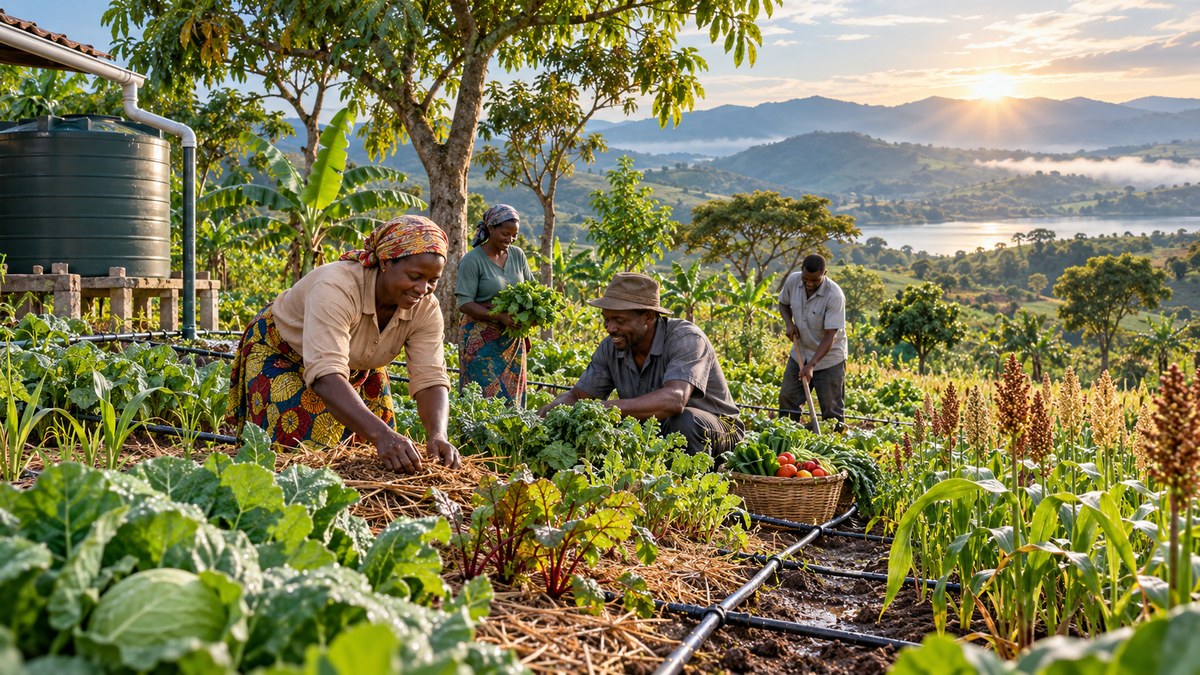
5 Ways Smallholder Farmers Are Feeding the World Through Climate-Resilient Agriculture
The world is full of big problems. Climate change is one of the biggest. But some of the most effective solutions are not high tech or expensive. They are rooted in local knowledge and a deep connection to the land. Smallholder farmers, the millions of families who work small plots around the globe, are not just victims of a changing climate. They are innovators. They are adapting, testing, and feeding their communities. Their methods offer a blueprint for anyone serious about food security in 2026.
Climate resilient agriculture smallholder farmers are not passive victims of drought and flood. They actively regenerate soil, harvest rainwater, and diversify crops. These practices boost yields, protect against extreme weather, and feed millions. For program managers and policy advisors, investing in farmer led adaptation is the most proven path to food security in 2026.
What Makes a Farm Climate Resilient?
Resilience is not about bouncing back to the way things were. It is about bouncing forward into a more stable system. For a small farm, that means building buffers. A farm that can survive a dry spell and still produce food is resilient. A farm that loses everything in a flood is not.
Climate resilient agriculture smallholder farmers use a mix of old wisdom and new science. They do not rely on a single crop or a single source of water. They build systems that work like a healthy forest. Layers of plants, healthy soil, and careful water management all play a role.
Here are the core principles that define a climate resilient farm:
- Diverse plantings instead of a single crop.
- Living soil covered with mulch or cover crops.
- Water storage both above and below ground.
- Local seeds adapted to regional stress.
- Integrated animals that recycle nutrients.
Five Proven Strategies in Action
These strategies are not theoretical. They are used every day by farmers across Africa, Asia, and Latin America. Here are five of the most effective approaches.
1. Agroforestry: Trees as a Safety Net
Trees are the ultimate multi tool for a farm. They provide shade that cools the soil and reduces water loss. Their roots hold the ground together during heavy rain. Many trees also fix nitrogen, which feeds the crops around them.
A farmer in Kenya might plant maize alongside acacia trees. The acacia provides shade and leaves that become mulch. When the maize harvest is poor, the farmer can sell firewood or fruit from the trees. This creates a buffer against total crop failure.
2. Water Harvesting and Micro Irrigation
Waiting for rain is a losing game. Climate resilient agriculture smallholder farmers actively capture water when it falls. Simple techniques make a huge difference.
One of the most effective methods is building swales. These are shallow ditches dug on contour lines. They catch runoff and let it soak into the ground. This recharges groundwater and keeps moisture available during dry spells. Drip irrigation kits powered by a small solar pump can then water vegetables with very little waste.
3. Soil Health as the Foundation
Healthy soil holds more water and more carbon. It also feeds plants better. Farmers build soil health by adding compost, leaving crop residues on the field, and rotating crops.
Cover crops are a popular tool. A farmer might plant cowpea after harvesting maize. The cowpea covers the soil, preventing erosion, and adds nitrogen. When the next rainy season begins, the soil is alive and ready.
4. Seed Saving and Local Varieties
Global seed companies sell hybrids that need lots of water and fertilizer. These are risky for small farms. Instead, farmers save seeds from the plants that survive tough conditions. Over generations, these seeds become locally adapted.
A drought resistant bean variety from Zimbabwe might need half the water of a commercial bean. A flood tolerant rice from Bangladesh can survive being submerged for weeks. These local varieties are a living library of climate solutions.
5. Diversified Income Streams
A farm that only sells maize is fragile. If the price drops or the crop fails, the family has nothing. Resilient farms have multiple income streams. They might sell vegetables, eggs, honey, and timber.
This mix means that if one market fails, others can keep the family afloat. It also spreads out the labor across the year. There is always something to harvest or sell.
Common Mistakes vs. Smart Investments
Not every intervention works. Some well meaning projects actually make things worse. The table below shows common pitfalls and the smarter alternatives used by successful programs.
| Common Mistake | Why It Fails | Climate Resilient Alternative |
|---|---|---|
| Distributing free chemical fertilizer | Creates dependency, kills soil life, and washes away in rain. | Invest in composting training and local bio fertilizer production. |
| Introducing high yield hybrid seeds without testing | Seeds need high inputs and fail under drought or flood stress. | Support community seed banks that multiply locally adapted varieties. |
| Building deep borewells for irrigation | Drops water table, expensive to maintain, and fails during drought. | Build surface water harvesting ponds and swales for groundwater recharge. |
| Promoting a single cash crop for export | Leaves farm vulnerable to price crashes and pest outbreaks. | Encourage diverse plantings for home consumption and local markets. |
| Providing livestock without feed or water plans | Animals die or damage the environment during dry seasons. | Integrate livestock with fodder trees and rotational grazing systems. |
“The best climate adaptation is a farmer who knows their land. Outside experts should listen first and prescribe second. The solutions are already in the ground.” – Dr. Amina Ouedraogo, agroecology researcher at the University of Ouagadougou.
How to Design a Farmer Led Program
If you are a program manager or policy advisor, you need a practical process. Here is a simple numbered framework that works across contexts.
-
Listen to local knowledge. Spend time with farmers during the dry season and the rainy season. Ask what changes they have seen. Ask what they have tried. This is your baseline.
-
Identify existing resilient practices. Find the farmers whose fields look healthier during a drought. They are your local experts. Learn from them before introducing anything new.
-
Test interventions on small plots. Do not roll out a new seed variety across 500 farms. Test it on three. Let farmers observe the results and decide if they want to adopt it.
-
Build peer to peer learning networks. Farmers trust other farmers more than they trust outsiders. Set up demonstration days where early adopters show their results to neighbors.
-
Monitor soil and water changes over time. Measure soil organic matter, water infiltration rates, and yields. Share these numbers with the community so they can see what works.
The Role of Policy and Investment
Individual farmers cannot solve this alone. They need supportive policies and smart investment. Governments and NGOs can help by funding research into local seeds, providing small grants for water harvesting structures, and removing subsidies that favor industrial farming.
For example, a program in Ethiopia gave small grants to women farmers to build rainwater collection tanks. Within two years, those families had vegetables year round and were selling surplus at local markets. The investment was small. The impact was huge.
You can read more about similar approaches in our article on building resilient food systems to end global hunger. Another useful resource is our piece on empowering local food initiatives to end hunger worldwide.
A Future Grown by Small Hands
Climate resilient agriculture smallholder farmers are not a niche interest. They are the backbone of global food supply. They produce over a third of the world’s food on less than a quarter of the farmland. When we support them, we support everyone.
The next time you see a report about climate change and food, remember the farmer in Malawi planting trees between her maize rows. Remember the woman in India saving seeds from the strongest bean plants. Their daily work is the most effective climate adaptation strategy we have.
If you are designing a program or writing a policy, start by talking to those farmers. Their fields are the laboratories of the future. Your job is to listen, learn, and help them scale what already works.
For more ideas on strengthening local food systems, check out our guide on how community-led food security programs are transforming lives worldwide. And for a deeper look at the link between farming and nutrition, read about why micronutrient deficiencies are the hidden hunger crisis in 2026.
The tools are simple. The results are powerful. The time to act is now.