Why SNAP Benefits Alone Won’t Solve Rural Food Deserts—and What Will
Imagine a family in rural Mississippi. Mom works two jobs. Dad drives a truck. The nearest grocery store is forty-five miles away. Their SNAP benefits arrive on time every month, but that doesn’t solve the fundamental problem: there is nowhere within a reasonable distance to buy fresh produce, lean meat, or whole grains. They end up spending their benefits at a gas station convenience store, buying shelf-stable items that are high in sodium and low in nutrition.
This is the reality for millions of Americans living in rural food deserts. The Supplemental Nutrition Assistance Program (SNAP) is a critical lifeline. It reduces poverty and hunger. But it was never designed to solve a logistics and infrastructure crisis. You cannot spend a benefit on a store that does not exist. So if we are serious about rural food deserts solutions, we need to look beyond the benefit card and at the systems that put food on the table in the first place.
SNAP benefits provide essential purchasing power but cannot build a grocery store, fund a delivery route, or fix a broken supply chain. Real solutions for rural food deserts require a mix of mobile markets, food cooperatives, regional food hubs, and policy changes that address the root causes of low access. Cash alone is not enough.
Why SNAP Benefits Hit a Wall in Rural America
The math is simple. SNAP gives a household money to buy food. But if the nearest retailer that accepts SNAP is a dollar store with a limited produce section, the household cannot buy fresh vegetables. The USDA defines a food desert as a low-income area where a significant number of residents are more than ten miles from a supermarket. In those places, SNAP is like a gift card to a store that does not exist.
The problem is not the benefit amount. It is the absence of a place to spend it. A 2023 report from the USDA Economic Research Service found that rural counties have lost nearly half of their grocery stores since the 1990s. Small independent grocers cannot compete with big box margins. They close. And when they close, the nearest option becomes a gas station or a dollar store.
This is where the policy conversation often stops. People say, “Just increase SNAP benefits.” But increasing benefits without increasing access is like giving someone a bigger bucket when there is no well to draw from. We need rural food deserts solutions that tackle the supply side of the equation.
The Three Pillars of Real Rural Food Access
To move beyond SNAP, we have to build infrastructure. Here are the three pillars that any effective strategy must include.
1. Mobile Markets and Delivery Networks
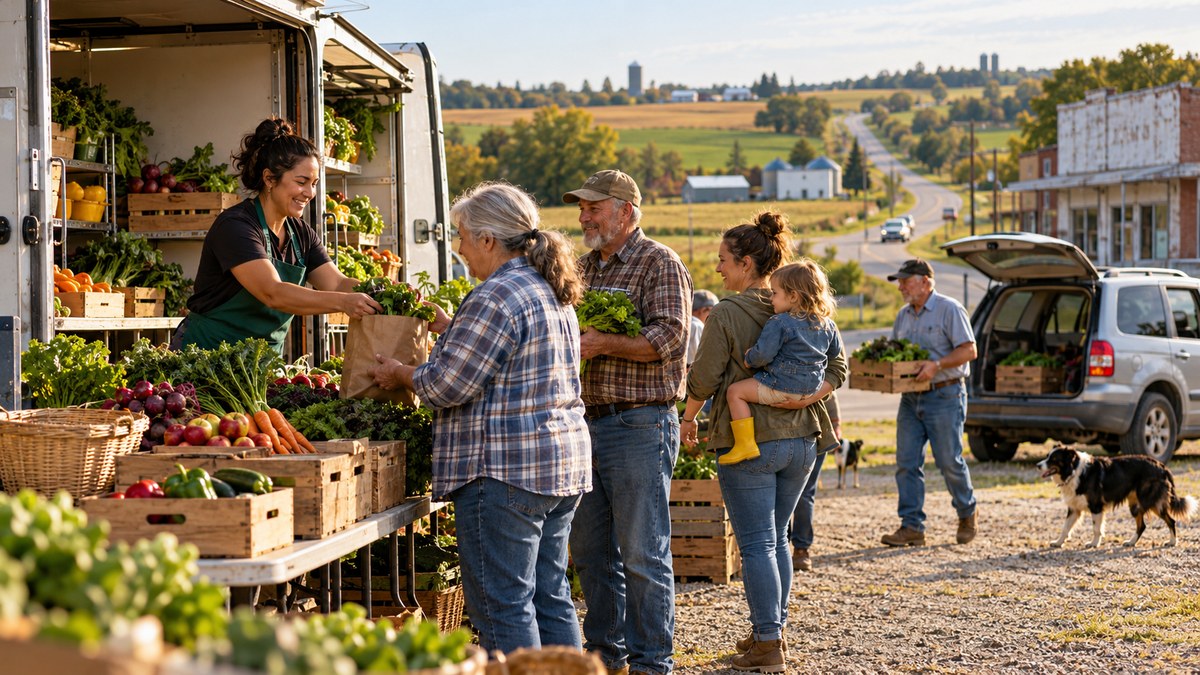
A grocery store on wheels can serve multiple communities in a single day. Mobile markets are not a new idea, but they are gaining traction as a scalable solution. Organizations like the Rural Grocery Initiative in Kansas have piloted mobile programs that bring fresh produce, dairy, and meat to towns that lost their only store.
The key is frequency and reliability. A mobile market that shows up every Tuesday at 10 AM becomes part of the weekly routine. People plan around it. It works best when combined with online ordering, so customers can pre-pay with SNAP benefits and pick up their bags when the truck arrives.
2. Food Cooperatives and Community-Owned Stores
When a for-profit grocer leaves, the community can step in. Food cooperatives are member-owned stores that prioritize fresh food over shareholder profit. They require upfront investment and strong local leadership, but they are remarkably resilient.
The best example is the Okracoke Food Co-op in North Carolina. That island community lost its only grocery store. Residents pooled resources, secured grants, and opened a co-op that now serves both locals and tourists. It is not a charity. It is a business that answers to its members. This model works especially well in towns with a strong sense of identity and volunteer networks.
3. Regional Food Hubs and Supply Chain Reform
Rural food deserts are often the result of broken supply chains. Small farmers cannot afford to distribute to tiny stores. Large distributors only service high-volume accounts. Regional food hubs bridge that gap. They aggregate products from local farms, process them, and distribute them to schools, hospitals, and small retailers.
A food hub can make it profitable for a farmer to sell to a rural school district fifty miles away. It creates a local food economy that does not depend on a single corporate retailer. The USDA has invested in food hubs through the Local Food Promotion Program, but funding is limited. Scaling this model requires dedicated state and federal support.
A Practical Process for Advocates
If you are a policy researcher or social advocate looking for rural food deserts solutions, here is a step-by-step process to evaluate and implement them.
-
Map the actual access gaps. Do not rely on USDA designations alone. Drive the routes. Talk to residents. Find out where people are currently buying food and how far they travel. This ground truth will reveal whether a mobile market, a co-op, or a delivery service makes the most sense.
-
Identify existing community assets. Is there a church with a commercial kitchen? A school bus that sits idle in the summer? A local farmer who wants to sell more? These assets can become the foundation of a solution without requiring a massive capital investment.
-
Pilot a low-cost intervention first. Start with a monthly mobile market or a pop-up farm stand. Measure participation, spending patterns, and resident satisfaction. Use that data to apply for larger grants from the USDA, state health departments, or philanthropic foundations.
-
Build a coalition of unlikely partners. The local hospital, the school district, the county health department, and the extension office all have a stake in food access. Bring them together. A hospital might fund a mobile market because it reduces diet-related disease. A school district might become a food hub anchor by sourcing local produce for school lunches.
-
Advocate for policy changes that support non-retail models. Current SNAP rules make it hard for mobile markets and food co-ops to accept benefits. The application process is designed for brick-and-mortar stores. Advocate for streamlined SNAP authorization for alternative retailers. Push for state-level grants that fund food hub infrastructure.
Common Mistakes and Better Approaches
Even well-intentioned projects can fail. Here is a table that outlines common mistakes and how to avoid them.
| Mistake | Why It Fails | Better Approach |
|---|---|---|
| Only focusing on one solution | A single mobile market cannot serve a whole county. | Layer multiple solutions: mobile, co-op, and delivery. |
| Ignoring transportation barriers | People without cars cannot reach a centralized food hub. | Use a decentralized pick-up model at community centers. |
| Assuming SNAP covers all costs | SNAP does not pay for transportation, storage, or labor. | Secure operational funding from grants or local government. |
| Not involving residents in planning | Solutions built without community input often fail. | Form a resident advisory board from the start. |
| Overlooking seasonality | Local produce is not available year-round. | Partner with regional distributors for winter supply. |
What the Research Says About Blended Approaches
A growing body of evidence shows that the most effective rural food deserts solutions combine multiple strategies. A study published in the Journal of Nutrition Education and Behavior found that communities with both a mobile market and a community garden saw a 30 percent increase in fruit and vegetable consumption compared to communities with only one intervention.
Another study from the University of Vermont looked at food hubs in the Northeast. It found that hubs that partnered with schools and healthcare facilities were more financially sustainable than those that relied solely on retail sales. The lesson is clear: do not build a solution in isolation. Connect it to existing institutions that have stable funding and a mission aligned with food access.
“We cannot solve rural food deserts by mailing people food stamps and hoping for the best. We have to rebuild the infrastructure that makes healthy food available in the first place. That means investing in transportation, processing, and distribution systems that serve rural communities.” – Dr. Amelia Stone, Rural Food Access Researcher, University of Georgia
This quote gets to the heart of the issue. SNAP is a tool. It is a good tool. But it is not the only tool, and it cannot do the job alone.
How Technology Can Fill the Gaps
Technology is not a silver bullet, but it can make existing solutions work better. Online ordering platforms allow SNAP recipients to pre-order from mobile markets and pay with their benefits through the USDA’s Online Purchasing Pilot. That pilot expanded significantly during the pandemic and is now available in most states.
Route optimization software helps mobile markets plan efficient routes that serve the most people with the least fuel. Inventory management systems reduce food waste by tracking what sells and what does not. These are not flashy innovations, but they make a real difference in the bottom line.
For advocates, pushing for broadband access in rural areas is a food access issue. Without reliable internet, online ordering and delivery coordination become impossible. This is one more reason why rural food deserts solutions must be cross-sectoral. You cannot solve food access without also solving internet access.
A New Way to Think About SNAP
This does not mean SNAP is broken. It means we need to expand our definition of what a food assistance program should do. Some states are experimenting with SNAP incentive programs that double the value of benefits spent at farmers markets. Others are allowing SNAP benefits to be used for home delivery from online retailers like Amazon and Walmart.
These are steps in the right direction, but they still assume a functioning retail environment. In rural food deserts, the retail environment is the problem. So we need to use SNAP as a lever to create that environment. That could mean offering higher reimbursement rates for small rural grocers that accept SNAP. It could mean funding SNAP-authorized mobile markets through a special USDA grant program.
The point is that SNAP policy and rural development policy should be the same conversation. Right now, they are treated as separate silos. That has to change.
Building Resilient Food Systems from the Ground Up
The most sustainable rural food deserts solutions are the ones that build local capacity. A mobile market run by a regional nonprofit is great, but what happens when the grant runs out? A food co-op owned by the community has staying power because the members are invested in its success.
This is where the work of organizations like Food First becomes critical. By funding community-led initiatives and supporting local food systems, we move beyond charity and into empowerment. When a community owns its food supply, it is less vulnerable to market shocks, supply chain disruptions, and policy changes.
If you want to see what this looks like in practice, read about how community-led food security programs are transforming lives worldwide. The same principles apply in rural Mississippi as they do in rural Kenya. Local ownership. Local leadership. Local solutions.
What Policymakers Can Do Right Now
For the policy researchers and advocates reading this, here are three concrete actions that can move the needle.
-
Support the Rural Grocery Store Initiative. This federal program provides technical assistance and grants to communities that have lost their only grocery store. It is underfunded and underutilized. Advocating for increased appropriations is a direct way to address supply-side gaps.
-
Reform SNAP retailer requirements. The current rules make it hard for mobile markets, food co-ops, and small stores to become authorized SNAP retailers. Simplifying the application process and reducing the minimum stocking requirements for rural areas would open up more places for people to use their benefits.
-
Fund food hub infrastructure. Regional food hubs need cold storage, processing equipment, and delivery vehicles. These are expensive. State and federal grants that specifically target food hub development in rural areas can create the backbone for a new food economy.
These are not radical ideas. They are practical, evidence-based steps that have been proven to work in pilot programs across the country. The barrier is not knowledge. It is political will and funding.
A Future Where Access Is Not a Luxury
Imagine a rural town in 2030. A food co-op sits on Main Street. A mobile market stops at the community center every Wednesday. The school district sources its apples and sweet potatoes from a regional food hub. SNAP benefits are accepted everywhere, and the local economy is stronger because the food dollars stay in the community.
That future is possible. It will not be built by SNAP alone. It will be built by communities, advocates, and policymakers working together to create rural food deserts solutions that address the root causes of low access.
For a deeper look at how these strategies fit into the bigger picture of global food security, check out building resilient food systems to end global hunger. The same principles that work in rural America work around the world. Local food systems are resilient food systems.
And if you are looking for a hands-on guide to starting a food cooperative in your own community, how to launch a community food cooperative that actually lasts is an excellent resource.
The Path Forward Is Community-Driven
The conversation around food access has been dominated by a single question for too long: “How do we get more benefits to more people?” That question matters, but it is incomplete. The better question is: “How do we build communities where everyone has access to healthy food, regardless of how far they live from a supermarket?”
The answer involves SNAP. It also involves mobile markets, food co-ops, regional hubs, smart policy, and community ownership. No single solution will fix rural food deserts. But a combination of strategies, grounded in local needs and supported by evidence, can transform the landscape.
So take these ideas back to your community. Start a conversation. Map the gaps. Find the assets. Build the coalition. The work is hard, but it is worth it. Because every family deserves a place to buy a fresh tomato, a head of lettuce, or a carton of eggs. Not just a place to spend a benefit, but a place to find real food.